
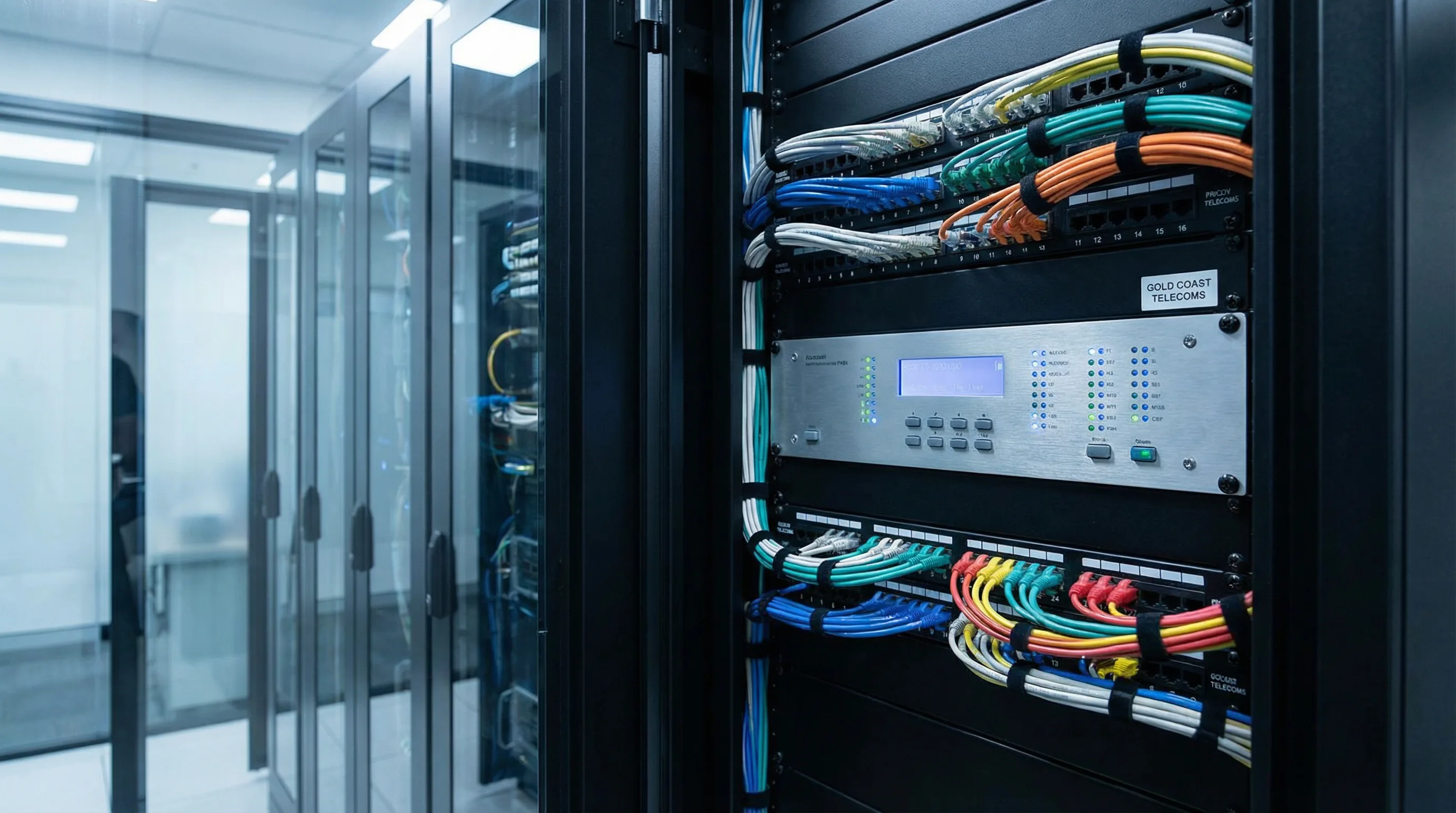
bcom ICT supplies, installs, programs and maintains on-premise PBX phone systems across the Gold Coast — including new system design, handset supply and commissioning — covering LG Ericsson iPECS, Panasonic KX-NS, KX-TDA and KX-TDE, NEC UNIVERGE SV9100, SV8100 and SL2100, and Alcatel-Lucent OmniPCX and OXO Connect. bcom ICT continues to support legacy systems that many providers no longer service. Call 07 3041 8993.
Systems we supply, install and support
LG Ericsson iPECS
Installation, programming, extension changes, call flow updates and fault diagnosis. Still a capable platform and rarely worth replacing while it works.
Panasonic KX-NS, KX-TDA, KX-TDE
Widely installed across Gold Coast businesses and increasingly orphaned as providers move to cloud-only. We still service them.
NEC UNIVERGE SV9100, SV8100, SL2100
Programming, moves and changes, hardware faults and expansion. Common in professional practices and multi-line reception environments.
Alcatel-Lucent OmniPCX & OXO Connect
Less common locally, which is exactly why finding anyone to touch one is difficult. We do.
The problem we most often solve
A business has a phone system that works. A staff member leaves, an extension needs reassigning, the after-hours message needs changing — and the company that installed it has moved to cloud-only and will not come out. The business is then told the only option is a full replacement.
Sometimes replacement genuinely is the right call. Often it is not, and the quote is being driven by who is available rather than by what the system needs. We will assess honestly how much life is left, what it would cost to keep running, and what a sensible replacement timeline looks like — so it becomes a planned capital decision rather than a forced one.
What we do on a PBX
- Extension adds, moves and changes — new starters, departures, desk swaps
- Call flow and hunt group programming, including after-hours and holiday handling
- Auto-attendant menus and recorded announcements
- Voicemail configuration, including voicemail-to-email where the system supports it
- Fault diagnosis and hardware replacement, including sourcing parts for older platforms
- Relocation during an office move, including number porting
- Honest assessment of remaining life, and planning the eventual move to VoIP when it makes sense
How much does a business phone system cost?
Handsets and installation are fixed price. The monthly plan is quoted alongside it.
Installation, per handset
- Handset provisioned, configured and tested
- Your existing numbers ported across
- Call flow, hunt groups and after-hours routing set up
- Staff shown how to actually use it
VoIP handset
- Business-grade desk handset
- Configured before it arrives on your desk
- Works the same from the office or from home
- Warranty handled by us rather than by you
Typical five-extension system
- Five handsets at $350 + GST each
- Installation and configuration at $500 + GST
- Numbers ported and call flow configured
- Monthly service and call plan quoted separately
Hardware and installation are a one-off fixed price, agreed before we start. The monthly service and call plan is separate and depends on how many numbers and concurrent calls you need — we quote it alongside the install so you are looking at the whole cost rather than the attractive half of it. A business that does not want desk phones can run softphones on the computers and mobiles it already owns, which removes the hardware line entirely and leaves only the installation.
The PBX problems we are actually called to
Six situations. The most common one is a working system with nobody left to maintain it.
“Our installer has retired”
Usually the single most common reason a business with a working PBX calls anyone. The system is fine and the knowledge has gone.
What we do Recover administrative access and document the configuration. A platform nobody can change is not a broken platform, and being told to replace it is not the same as needing to.
“We can’t change our own greeting”
Usually a system handed over without its credentials or its documentation, which is how most of them were handed over.
What we do Make the change and then leave you able to make it yourself. If a business has to book a technician to alter an after-hours message, something has gone wrong that is not technical.
“Half the phones went out after a power failure”
Usually a card, a power supply or a component that did not survive the event. Older systems are more exposed to power disturbance than most equipment in a building.
What we do Identify precisely what failed and whether it can be replaced, then protect the system properly. A PBX on unconditioned power in a building with supply problems will keep doing this.
“We want people working from home on the same number”
Usually a requirement most legacy systems were never designed for. It does not automatically mean replacing everything.
What we do Consider a hybrid — the existing system for the office, cloud extensions for people outside it, joined so one number reaches whoever is available. Frequently a fraction of a full replacement.
“We’ve been told the system is end of life”
Usually sometimes accurate and sometimes a sales position. What matters is whether parts are obtainable, whether it does what the business needs, and what the alternative costs.
What we do Get an honest assessment with both paths costed. We supply new systems and we support old ones, so we have no structural reason to prefer either answer.
“We’re moving premises and want to keep the system”
Usually usually possible and usually underestimated. The system moving is the easy part; the services and the cabling at the new site are not.
What we do Plan the numbers, the services and the cabling well before the move rather than during it. Phones are the part of a relocation most often left to last and least able to absorb a delay.
What PBX work actually looks like
Representative engagements, drawn from real work with identifying detail removed — we don’t name clients without written permission.
Keeping the office system and adding the people who were not in it
The situation
A business with a healthy PBX needed six staff working from home to be reachable on the main number. Two providers had quoted for full cloud replacements, and the directors could not see why a working system had to be discarded.
What we found
The existing platform suited the sixteen people in the building and was not designed to extend beyond it. Replacing it entirely would have solved a problem affecting six people by discarding equipment serving sixteen, which nobody had questioned because nobody had proposed anything else.
What we did
Kept the PBX for the office, added cloud extensions for the six remote staff, and joined the two so a single published number rings whoever is available regardless of location.
The outcome
Everyone has a working phone and the business spent a small fraction of a replacement. The PBX will be replaced when it genuinely reaches its end, which is a decision the business now gets to make on its own timing.
Moving a phone system without losing a day
The situation
A business relocating within the Gold Coast wanted to take its phone system to the new premises and be operating from the first morning. The move was over a weekend.
What we found
The system itself would move without difficulty. The new tenancy had phone points of unknown vintage connected to nothing identifiable, no structured cabling to the positions the business intended to use, and services that had to be arranged with lead times longer than the business had allowed.
What we did
Ran cabling to every position through an ACMA registered contractor three weeks ahead, arranged the services with time to spare, and configured and tested the system against the new cabling while the old site was still trading.
The outcome
The business moved on the Saturday and worked on the Monday. On moving day the system was carried in and connected to outlets already proven to work, which is the whole point of doing the preparation early.
Questions Gold Coast businesses ask us
Who services PBX phone systems on the Gold Coast?
bcom ICT installs, programs and maintains on-premise PBX systems on the Gold Coast, including LG Ericsson iPECS, Panasonic KX-NS, KX-TDA and KX-TDE, NEC UNIVERGE SV9100, SV8100 and SL2100, and Alcatel-Lucent OmniPCX and OXO Connect — including legacy systems many providers no longer service. Call 07 3041 8993.
Our provider says we have to replace our system. Is that true?
Sometimes, but frequently it reflects who is available rather than what the system needs. If the platform still does what your business requires and parts are obtainable, keeping it is often the cheaper answer. We will give you an honest assessment of remaining life before you commit to a replacement.
Can you just reprogram ours without taking over support?
Yes. Plenty of clients call us for a one-off change — an extension, a call flow, an after-hours message — charged at the standard rate. There is no requirement to sign up to anything ongoing.
Can you still get parts for older systems?
For the platforms listed above, usually yes. Where a part is genuinely unobtainable we will tell you, because that is the point at which replacement stops being optional and becomes a planning exercise.
Should we move to VoIP instead?
Eventually most businesses will. Whether now is the right time depends on whether your hardware is failing, whether you need remote extensions, and whether your internet connection is reliable enough. We'll test the connection and give you a straight answer rather than a default one.
Can you move our PBX to a new office?
Yes. PBX relocation, recabling and number porting are handled as part of an office IT relocation, planned around your move date rather than attempted on the day.
Got a system nobody will touch?
Tell us the make and model. If it's on our list, you probably don't need the replacement you've been quoted.